A tabula ansata or tabella ansata (Latin for tablet with handles, plural tabulae ansatae or tabellae ansatae) is a tablet with dovetail handles.[1] It was a favorite form for votive tablets in Imperial Rome.[2]


Overview
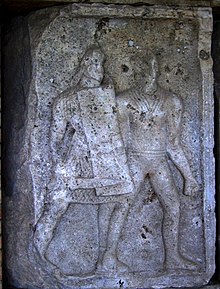
Tabulae ansatae identifying soldiers' units have been found on the tegimenta (leather covers) of shields, for example in Vindonissa (Windisch, Switzerland).[3] Sculptural evidence, for example on the metopes from the Tropaeum Traiani (Adamclisi, Romania), shows that they were also used for the same purpose on the shields.[4]
Modern era
Tabulae ansatae have been used by modern artists from as early as the 15th century, as shown on the tomb of Charles, Count of Maine, attributed to Francesco Laurana, in Le Mans Cathedral.[5] The Statue of Liberty by sculptor Auguste Bartholdi is holding one such tablet on which "July 4th 1776" is inscribed using Roman numerals.
Gallery



This article uses material from the Wikipedia article
Metasyntactic variable, which is released under the
Creative Commons
Attribution-ShareAlike 3.0 Unported License.
Metasyntactic variable, which is released under the
Creative Commons
Attribution-ShareAlike 3.0 Unported License.