A circular rampart (German: Ringwall) is an embankment built in the shape of a circle that was used as part of the defences for a military fortification, hill fort or refuge, or was built for religious purposes or as a place of gathering.
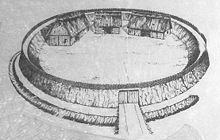
The period during which these structures were built ranged from the Neolithic to the Middle Ages.
Construction

The key feature of a circular rampart is that the embankment formed the primary element of the defensive fortification. It can be constructed in various ways: as a simple earth embankment, as a wood and earth structure, or as a wall. Circular ramparts usually have a moat or ditch in front of them; the embankment can be enhanced with a wooden palisade. Often several concentric rings were built, which produced a more effective defensive position against attackers. The interior of such sites often shows evidence of buildings such as halls, barns, and other secondary structures.
Locations


Circular ramparts are found in north and western Europe, for example, in Denmark, Estonia, Sweden, Germany, Great Britain, Belgium and the Netherlands; in central Europe, in Austria and Switzerland; in southeastern Europe in Romania, Moldova and Ukraine;[1] and also in the United States. They are often hidden in woods and discovered by aerial photography. Archaeological profiles through the defences and excavations of the interior enable analysis of the period the site was occupied, the pottery used and the type of food consumed.
Notable circular ramparts

| This article uses material from the Wikipedia article Metasyntactic variable, which is released under the Creative Commons Attribution-ShareAlike 3.0 Unported License. |