The xylospongium or tersorium, also known as sponge on a stick, was a hygienic utensil used by ancient Romans to wipe their anus after defecating,[1] consisting of a wooden stick (Greek: ξύλον, xylon) with a sea sponge(Greek: σπόγγος, spongos) fixed at one end.

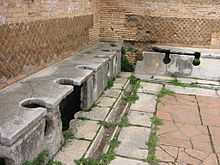
The tersorium was shared by people using public latrines. To clean the sponge, they simply washed it in a bucket with water and salt or vinegar.[2] This became a breeding ground for bacteria, causing the spread of disease in the latrine.[3]
In classical antiquity a xylospongium might be used as a toilet brush.[4]
In the baths of the seven sages in Ostia, a fresco from the 2nd century contains the Inscription (u)taris xylosphongio[5] which is the first known mention of the term. Also in the early second century a papyrus letter of Claudius Terentianus to his father Claudius Tiberianus uses the term xylespongium in a phrase.[6]
In the middle of the first century Senecareported that a Germanic gladiator had committed suicide with a sponge on a stick. The Germanic gladiator hid himself in the latrine of an amphitheater and pushed the wooden stick into his gullet and choked to death.[7]
| This article uses material from the Wikipedia article Metasyntactic variable, which is released under the Creative Commons Attribution-ShareAlike 3.0 Unported License. |